MySQL-实战-窗口函数
窗口函数 MySQL8 窗口函数是一种特殊的函数,它可以在 一组查询行上执行类似于聚合的操作 ,但是 不会将查询行折叠为单个输出行 ,而是为每个查询行生成一个结果。窗口函数可以用来处理复杂的报表统计分析场景,例如计算移动平均值、累计和、排名等。它展现的主要威力在于「 它能够让我们在不修改原有语句输出结果的基础上,直接添加新的聚合字段 」。 语法解析 window function name window functi…
窗口函数
MySQL8 窗口函数是一种特殊的函数,它可以在一组查询行上执行类似于聚合的操作,但是不会将查询行折叠为单个输出行,而是为每个查询行生成一个结果。窗口函数可以用来处理复杂的报表统计分析场景,例如计算移动平均值、累计和、排名等。它展现的主要威力在于「它能够让我们在不修改原有语句输出结果的基础上,直接添加新的聚合字段」。
语法解析
window_function_name ( [argument1, argument2, ...] )
OVER  (
  [ PARTITION BY col1, col2, ... ]
  [ORDER BY col3, col4, ...]
  [ ROWS | RANGE frame_start AND frame_end ]
)
window_function_name
window_function_name 函数可以是聚合函数或者非聚合函数。MySQL8 支持以下几类窗口函数,
- 序号函数:用于为窗口内的每一行生成一个序号,例如 ROW_NUMBER(),RANK(),DENSE_RANK() 等。
- 分布函数:用于计算窗口内的每一行在整个分区中的相对位置,例如 PERCENT_RANK(),CUME_DIST() 等。
- 前后函数:用于获取窗口内的当前行的前后某一行的值,例如 LAG(),LEAD() 等。
- 头尾函数:用于获取窗口内的第一行或最后一行的值,例如 FIRST_VALUE(),LAST_VALUE() 等。
- 聚合函数:用于计算窗口内的某个字段的聚合值,例如 SUM(),AVG(),MIN(),MAX() 等。
OVER
OVER 关键字很重要,用来标识是否使用窗口函数,语法如下
over_clause:
    {OVER (window_spec) | OVER window_name}
两种形式都定义了窗口函数应该如何处理查询行。它们的区别在于窗口是直接在 OVER() 中定义,还是基于 window_name 在 OVER 字句可以重复使用。
- OVER() 常规用法,窗口规范直接出现在 OVER 子句中的括号之间。
- OVER window_name 基于 Named Windows,是由查询中其他地方的 WINDOW 子句定义的窗口规范的名称,可以重复使用。
PARTITION BY
PARTITION BY子句用来将查询结果划分为不同的分区,窗口函数在每个分区上分别执行,语法如下
partition_clause:
    PARTITION BY expr [, expr] ..
ORDER BY
order_clause:
    ORDER BY expr [ASC|DESC] [, expr [ASC|DESC]] ...
frame_clause
frame_clause 是窗口函数的一个可选子句,用来指定每个分区内的数据范围,可以是静态的或动态的。语法如下
frame_clause:
    frame_units frame_extent

frame_units:
    {ROWS | RANGE}
frame_units表示窗口范围的单位,可以是ROWS或RANGE。ROWS表示基于行数,RANGE表示基于值的大小。
frame_extent表示窗口范围的起始位置和结束位置,可以是以下几种形式:
- CURRENT ROW: 表示当前行。
- UNBOUNDED PRECEDING: 表示分区中的第一行。
- UNBOUNDED FOLLOWING: 表示分区中的最后一行。
- expr PRECEDING: 表示当前行减去expr的值。
- expr FOLLOWING: 表示当前行加上expr的值。
Named Windows
MySQL8的 Named Windows 是指在 WINDOW 子句中定义并命名的窗口,可以在 OVER 子句中通过窗口名来引用。使用 Named Windows 的好处是可以避免在多个OVER子句中重复定义相同的窗口,而只需要在 WINDOW 子句中定义一次,然后在 OVER 子句中引用即可。
SELECT
  val,
  ROW_NUMBER () OVER (ORDER BY val) AS 'row_number',
  RANK () OVER (ORDER BY val) AS 'rank',
  DENSE_RANK () OVER (ORDER BY val) AS 'dense_rank'
FROM numbers;
可以使用Named Windows来简化为:
SELECT
  val,
  ROW_NUMBER () OVER w AS 'row_number',
  RANK () OVER w AS 'rank',
  DENSE_RANK () OVER w AS 'dense_rank'
FROM numbers WINDOW w AS (ORDER BY val);
如果一个 OVER 子句使用了 OVER (window_name …) 而不是 OVER window_name,则可以在引用的窗口名后面添加其他子句来修改窗口。
SELECT
  DISTINCT year, country,
  FIRST_VALUE (year) OVER (w ORDER BY year ASC) AS first,
  FIRST_VALUE (year) OVER (w ORDER BY year DESC) AS last
FROM sales WINDOW w AS (PARTITION BY country);

- 可以根据不同的排序来获取每个国家的第一年和最后一年。
一个命名窗口的定义本身也可以以一个窗口名开头。这样可以实现窗口之间的引用,但不能形成循环。
SELECT
  val,
  SUM(val) OVER w1 AS sum_w1,
  SUM(val) OVER w2 AS sum_w2,
  SUM(val) OVER w3 AS sum_w3
FROM numbers
WINDOW
  w1 AS (ORDER BY val),
  w2 AS (w1 ROWS BETWEEN UNBOUNDED PRECEDING AND CURRENT ROW),
  w3 AS (w2 RANGE BETWEEN UNBOUNDED PRECEDING AND CURRENT ROW);
例题
CREATE TABLE `sales` (
  `id` int NOT NULL,
  `year` int DEFAULT NULL,
  `country` varchar(20) DEFAULT NULL,
  `product` varchar(20) DEFAULT NULL,
  `profit` int DEFAULT NULL,
  PRIMARY KEY (`id`)
) ENGINE=InnoDB DEFAULT CHARSET=utf8mb4 COLLATE=utf8mb4_0900_ai_ci;

INSERT INTO `test_db`.`sales` (`id`, `year`, `country`, `product`, `profit`) VALUES (1, 2000, 'Finland', 'Computer', 1500);
INSERT INTO `test_db`.`sales` (`id`, `year`, `country`, `product`, `profit`) VALUES (2, 2000, 'Finland', 'Phone', 100);
INSERT INTO `test_db`.`sales` (`id`, `year`, `country`, `product`, `profit`) VALUES (3, 2001, 'Finland', 'Phone', 10);
INSERT INTO `test_db`.`sales` (`id`, `year`, `country`, `product`, `profit`) VALUES (4, 2001, 'India', 'Calculator', 75);
INSERT INTO `test_db`.`sales` (`id`, `year`, `country`, `product`, `profit`) VALUES (5, 2000, 'India', 'Calculator', 75);
INSERT INTO `test_db`.`sales` (`id`, `year`, `country`, `product`, `profit`) VALUES (6, 2000, 'India', 'Computer', 1200);
INSERT INTO `test_db`.`sales` (`id`, `year`, `country`, `product`, `profit`) VALUES (7, 2000, 'USA', 'Calculator', 75);
INSERT INTO `test_db`.`sales` (`id`, `year`, `country`, `product`, `profit`) VALUES (8, 2000, 'USA', 'Computer', 1500);
INSERT INTO `test_db`.`sales` (`id`, `year`, `country`, `product`, `profit`) VALUES (9, 2001, 'USA', 'Calculator', 50);
INSERT INTO `test_db`.`sales` (`id`, `year`, `country`, `product`, `profit`) VALUES (12, 2002, 'USA', 'Computer', 1200);
INSERT INTO `test_db`.`sales` (`id`, `year`, `country`, `product`, `profit`) VALUES (13, 2001, 'USA', 'TV', 150);
INSERT INTO `test_db`.`sales` (`id`, `year`, `country`, `product`, `profit`) VALUES (14, 2002, 'USA', 'TV', 100);
INSERT INTO `test_db`.`sales` (`id`, `year`, `country`, `product`, `profit`) VALUES (15, 2001, 'USA', 'Computer', 1500);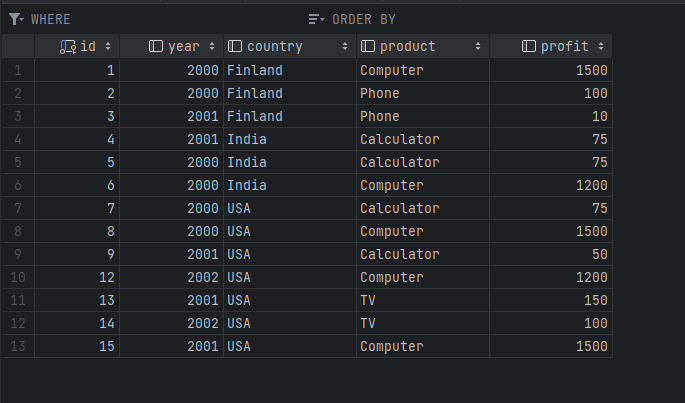
问题一
计算每个国家每年的总利润,并按照国家和年份排序
不使用窗口函数
SELECT year, country, SUM(profit) AS sum_profit
FROM sales
GROUP BY country, year
ORDER BY country, year;

+------+---------+------------+
| year | country | sum_profit |
+------+---------+------------+
| 2000 | Finland |       1600 |
| 2001 | Finland |         10 |
| 2000 | India   |       1275 |
| 2001 | India   |         75 |
| 2000 | USA     |       1575 |
| 2001 | USA     |       1700 |
| 2002 | USA     |       1300 |
+------+---------+------------+
使用窗口函数
SELECT year, country, SUM(profit) OVER (PARTITION BY country, year) AS sum_profit
FROM sales
ORDER BY country, year

+------+---------+------------+
| year | country | sum_profit |
+------+---------+------------+
| 2000 | Finland |       1600 |
| 2000 | Finland |       1600 |
| 2001 | Finland |         10 |
| 2000 | India   |       1275 |
| 2000 | India   |       1275 |
| 2001 | India   |         75 |
| 2000 | USA     |       1575 |
| 2000 | USA     |       1575 |
| 2001 | USA     |       1700 |
| 2001 | USA     |       1700 |
| 2001 | USA     |       1700 |
| 2002 | USA     |       1300 |
| 2002 | USA     |       1300 |
+------+---------+------------+每个国家每年的总利润都被计算出来了,但是没有折叠为单个输出行,而是为每个查询行生成了一个结果。
问题二
计算每个国家每种产品的销售排名,并按照国家和排名排序
不使用窗口函数
SELECT country, product, COUNT(1) AS sell_count
FROM sales
GROUP BY country, product
ORDER BY country, sell_count;

+---------+------------+------------+
| country | product    | sell_count |
+---------+------------+------------+
| Finland | Computer   |          1 |
| Finland | Phone      |          2 |
| India   | Computer   |          1 |
| India   | Calculator |          2 |
| USA     | Calculator |          2 |
| USA     | TV         |          2 |
| USA     | Computer   |          3 |
+---------+------------+------------+
这里,不使用窗口函数只能根据sell_count来进行排序,无法单独加上一列rank,如果必须要单独加上一列rank,需要涉及到 子查询 + 连接。是一个比较复杂的查询操作
使用窗口函数
SELECT country, product, COUNT(1) OVER (PARTITION BY country, product) AS sell_count
FROM sales
ORDER BY country, sell_count

+---------+------------+------------+
| country | product    | sell_count |
+---------+------------+------------+
| Finland | Computer   |          1 |
| Finland | Phone      |          2 |
| Finland | Phone      |          2 |
| India   | Computer   |          1 |
| India   | Calculator |          2 |
| India   | Calculator |          2 |
| USA     | Calculator |          2 |
| USA     | Calculator |          2 |
| USA     | TV         |          2 |
| USA     | TV         |          2 |
| USA     | Computer   |          3 |
| USA     | Computer   |          3 |
| USA     | Computer   |          3 |
+---------+------------+------------+
这里是使用窗口函数来实现根据sell_count排名,可以发现,这样使用窗口函数其实就是省下了GROUP BY分组
同时还能发现的是,如果直接使用GROUP BY,那么对于那些被分出来的小表中任然有超过一条的数据的来说,是无法输出的。
Expression #3 of SELECT list is not in GROUP BY clause and contains nonaggregated column 'test_db.sales.profit' which is not functionally dependent on columns in GROUP BY clause; this is incompatible with sql_mode=only_full_group_by使用窗口函数来优雅的解决
SELECT country, product, profit, RANK() OVER (PARTITION BY country ORDER BY profit DESC ) AS rank1
FROM sales
ORDER BY country, rank1;

+---------+------------+--------+-------+
| country | product    | profit | rank1 |
+---------+------------+--------+-------+
| Finland | Computer   |   1500 |     1 |
| Finland | Phone      |    100 |     2 |
| Finland | Phone      |     10 |     3 |
| India   | Computer   |   1200 |     1 |
| India   | Calculator |     75 |     2 |
| India   | Calculator |     75 |     2 |
| USA     | Computer   |   1500 |     1 |
| USA     | Computer   |   1500 |     1 |
| USA     | Computer   |   1200 |     3 |
| USA     | TV         |    150 |     4 |
| USA     | TV         |    100 |     5 |
| USA     | Calculator |     75 |     6 |
| USA     | Calculator |     50 |     7 |
+---------+------------+--------+-------+
这里我对窗口函数运行的理解如下,首先MYSQL 会忽略窗口函数,直接查询出结果,之后窗口函数会对原始查询出的结果按照 PARTITION BY 进行分组,按照 ORDER BY 进行排序,之后对于分好组的数据,运行 windows_function,得到结果,并将结果附加到原始数据的新列。
因此,窗口函数是在已经生成的查询结果基础上进行的“二次处理”,并不会影响到查询的其他部分。
问题三
计算每个国家每种产品的累计利润,并按照国家和利润排序
SELECT country, product, profit,
SUM(profit) OVER (PARTITION BY country ORDER BY profit
ROWS BETWEEN UNBOUNDED PRECEDING AND CURRENT ROW ) AS cumulative_profit
FROM sales
ORDER BY country, profit;

+---------+------------+--------+-------------------+
| country | product    | profit | cumulative_profit |
+---------+------------+--------+-------------------+
| Finland | Phone      |     10 |                10 |
| Finland | Phone      |    100 |               110 |
| Finland | Computer   |   1500 |              1610 |
| India   | Calculator |     75 |                75 |
| India   | Calculator |     75 |               150 |
| India   | Computer   |   1200 |              1350 |
| USA     | Calculator |     50 |                50 |
| USA     | Calculator |     75 |               125 |
| USA     | TV         |    100 |               225 |
| USA     | TV         |    150 |               375 |
| USA     | Computer   |   1200 |              1575 |
| USA     | Computer   |   1500 |              3075 |
| USA     | Computer   |   1500 |              4575 |
+---------+------------+--------+-------------------+
感觉窗口函数是真的厉害,这种查询我之前是没有任何思路的
问题四
基于Named Window 重写问题三
SELECT country, product, profit,
SUM(profit) OVER w1 AS cumulative_profit
FROM sales
WINDOW
w1 as (PARTITION BY country ORDER BY profit
ROWS BETWEEN UNBOUNDED PRECEDING AND CURRENT ROW)
ORDER BY country, profit
;
常用的窗口函数总结
| 函数名 | 用途 |
|---|---|
ROW_NUMBER() |
为查询结果中的每一行分配唯一的递增整数。 |
RANK() |
对结果集进行排名,相同值的行会共享同一排名,并且跳过排名。 |
DENSE_RANK() |
对结果集进行排名,相同值的行会共享同一排名,但不会跳过排名。 |
SUM() |
计算指定窗口内列的和。 |
MIN() |
返回指定窗口内列的最小值。 |
MAX() |
返回指定窗口内列的最大值。 |
AVG() |
计算指定窗口内列的平均值。 |
LAG() |
返回当前行的前一行的值。 |
LAG(N) |
返回当前行的前 N 行的值,N 为指定的行数。 |
LAG(col, n, DEFAULT) |
返回当前行的前 n 行的 col 列的值,如果不存在前 n 行,则返回默认值 DEFAULT。 |
LEAD() |
返回当前行的后一行的值。 |
LEAD(N) |
返回当前行的后 N 行的值,N 为指定的行数。 |
LEAD(col, n, DEFAULT) |
返回当前行的后 n 行的 col 列的值,如果不存在后 n 行,则返回默认值 DEFAULT。 |
FIRST_VALUE() |
返回指定窗口或分区内的第一个值。 |
LAST_VALUE() |
返回指定窗口或分区内的最后一个值。 |
NTILE() |
将结果集划分为n个桶,并将每一行分配到其中一个桶中。 |
PERCENT_RANK() |
计算当前行在分区内的百分比排名,结果介于 0 和 1 之间。 |
CUME_DIST() |
计算当前行及其之前的行在分区内的累积分布百分比,结果介于 0 和 1 之间。 |